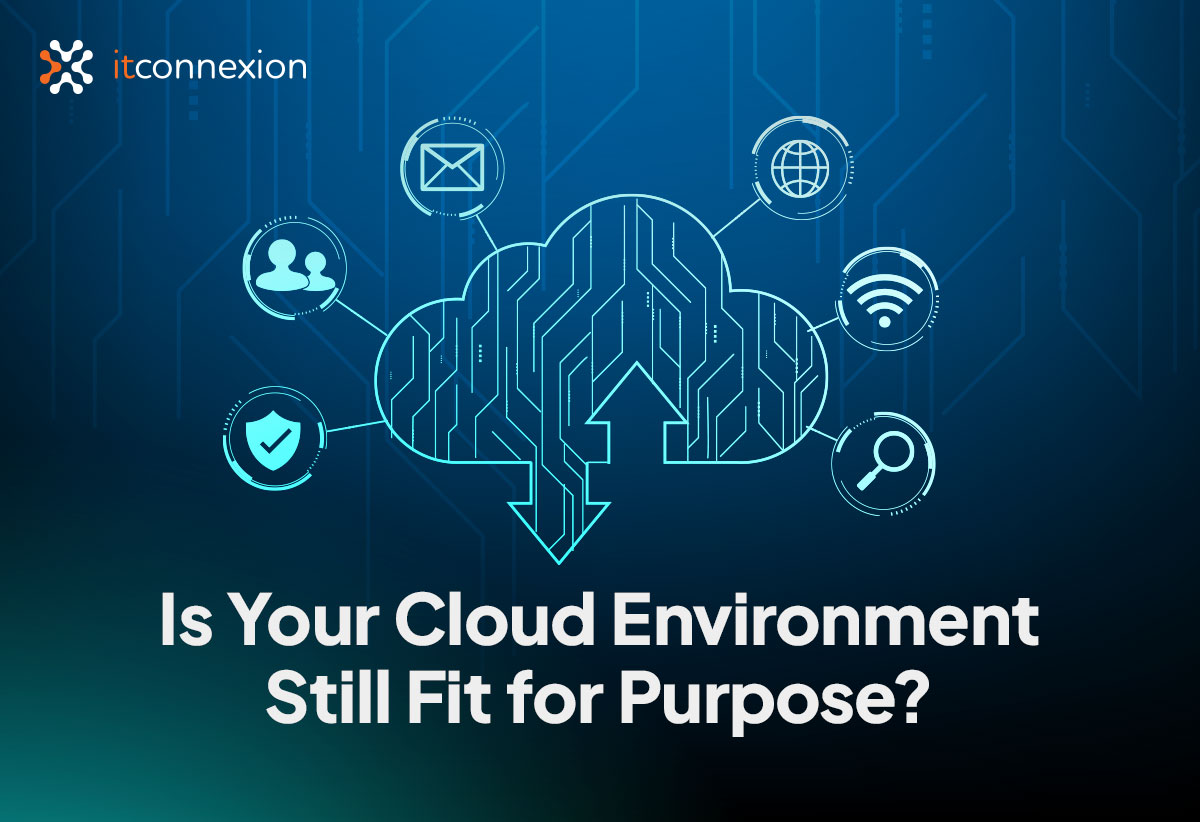
Cloud technology has become an essential part of how Australian businesses and organisations operate. From supporting hybrid work and collaboration to improving scalability, mobility, and business continuity, cloud platforms now play a central role in day-to-day operations.
However, many organisations adopted cloud services rapidly over recent years and have continued expanding their environments without revisiting the original strategy behind them.
What worked well several years ago may no longer align with the way your organisation operates today.
Over time, cloud environments can gradually become more complex, more expensive, harder to manage securely, and less aligned with operational requirements. In many cases, organisations are not experiencing major failures, but rather small inefficiencies, operational friction, rising costs, or increasing security exposure that slowly impact productivity and long-term growth.
This is why regular cloud reviews are becoming increasingly important for Australian organisations.
Many businesses also rely on cloud platforms as part of their broader Managed IT Services strategy to support modern operations, remote access, cyber security, and business continuity.
Cloud Reviews Are About More Than Security
When businesses hear the term “cloud review,” many immediately think about cyber security.
Security is certainly a key component, but a modern cloud review should go much further than that.
A properly structured review should assess whether your cloud environment is still:
- Supporting business growth
- Cost-effective and scalable
- Secure and compliant
- Optimised for hybrid work
- Delivering a positive user experience
- Aligned with operational workflows
- Suitable for future technology initiatives, including AI and automation
Sometimes the outcome is optimisation of the existing environment. In other cases, the review may identify opportunities for infrastructure modernisation or cloud migration.
The goal is not to replace technology unnecessarily, but to ensure the environment remains fit for purpose as the organisation evolves.
A structured review can also help organisations determine whether their existing Cloud Solutions environment is still aligned with operational requirements and future growth plans.
Signs Your Cloud Environment May Need a Review
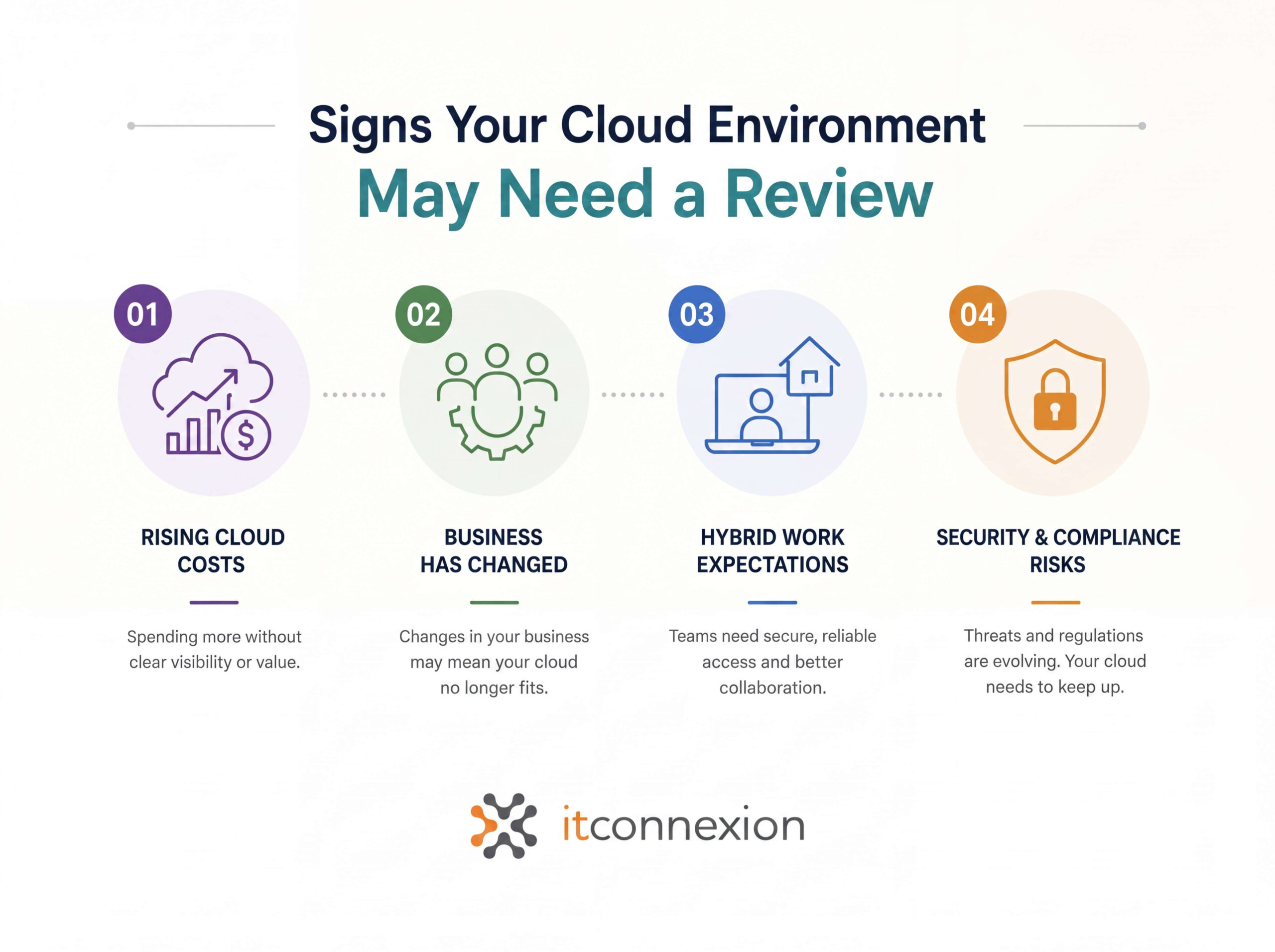
One of the most common challenges organisations experiences is increasing cloud costs over time without fully understanding why.
This often occurs due to:
- Unused or duplicated licenses
- Legacy systems still running unnecessarily
- Excessive cloud storage growth
- Underutilised resources
- Overlapping applications across departments
- Lack of governance around provisioning and access
Cloud optimisation is not simply about reducing costs. It is about ensuring resources are aligned appropriately with operational needs and future growth.
A review can help organisations improve visibility while identifying practical optimisation opportunities.
Technology environments should evolve alongside the organisation itself.
If your business has experienced growth, restructuring, acquisitions, remote workforce expansion, new office locations, or operational changes, your original cloud setup may no longer be the best fit.
This commonly affects:
- User permissions
- Collaboration workflows
- Security segmentation
- Data governance
- Application integrations
- System performance and scalability
Many organisations continue operating on cloud environments originally designed for a much smaller or simpler business structure.
Hybrid work has permanently changed how many Australian organisations operate.
Teams now expect reliable access to systems from anywhere, seamless collaboration, secure connectivity, and consistent user experiences across multiple devices and locations.
However, many cloud environments were implemented quickly during remote work transitions and may not have been fully optimised for long-term operational efficiency.
Questions organisations should revisit include:
- Are remote users experiencing performance issues?
- Are collaboration tools configured properly?
- Is data being shared securely?
- Are identity and access controls managed appropriately?
- Are staff using too many overlapping applications?
Optimising modern workplace solutions can significantly improve collaboration, productivity, and staff experience.
Cyber security threats targeting cloud environments continue to evolve rapidly.
Cloud platforms themselves are highly capable, but security remains a shared responsibility between the provider and the organisation.
A cloud review should assess areas such as:
- Multi-factor authentication (MFA)
- Identity and access management
- Privileged account controls
- Backup and recovery readiness
- Monitoring and visibility
- Third-party application access
- Data retention and governance
- Endpoint integration
For Australian organisations, cloud reviews are also increasingly important for cyber insurance requirements, privacy obligations, Essential Eight maturity uplift, and overall risk management.
Cloud reviews are increasingly becoming part of broader IT Security and operational resilience strategies.
Many organisations are also strengthening visibility through Managed Detection & Response services to improve monitoring and threat detection across cloud environments.
Businesses looking to strengthen cyber security posture can also refer to the ACSC Essential Eight framework published by the Australian Cyber Security Centre.
When Cloud Migration May Be the Right Step
Sometimes a review identifies that the current environment is no longer the best long-term solution.
This does not necessarily mean a full migration is immediately required. However, organisations may benefit from assessing whether newer cloud platforms, infrastructure models, or modern workplace solutions could better support future operations.
A Cloud Feasibility Review can help organisations evaluate:
- Operational suitability
- Migration complexity
- Business continuity considerations
- Risk management
- User adoption impacts
- Security improvements
- Cost implications
- Long-term scalability
The most successful cloud migrations are carefully planned and aligned with business outcomes rather than driven purely by technology trends.
Frameworks such as the Microsoft Azure Cloud Adoption Framework also highlight the importance of governance, planning, and operational alignment during cloud transformation initiatives.
Cloud Optimisation Is About Business Outcomes
A well-optimised cloud environment should help organisations become:
- More productive
- More secure
- Easier to manage
- More scalable
- Better prepared for disruption
- More adaptable to future growth
In many cases, relatively small adjustments can create significant operational improvements across the organisation.
Cloud optimisation is not only about infrastructure. It is about ensuring technology genuinely supports the way people work.
Cloud optimisation should also align with broader Business Continuity Planning objectives, including recovery readiness and operational resilience.
A Practical Example
Recently, ITConnexion worked with an Australian organisation reviewing their existing infrastructure and cloud readiness.
Through a structured feasibility assessment and migration strategy, the organisation improved remote accessibility, simplified system management, strengthened security visibility, and reduced operational complexity while minimising disruption to staff during the transition.
Importantly, the project focused not only on technology improvements, but also on supporting long-term operational outcomes and user experience.
Final Thoughts
Cloud environments should continue evolving alongside the organisations they support.
Regular reviews help ensure cloud platforms remain aligned with operational requirements, workforce changes, cyber security expectations, and long-term business goals.
For many Australian businesses and organisations, reviewing and optimising cloud environments is becoming an important part of maintaining resilience, productivity, and sustainable growth in a modern digital workplace.
In some cases, optimisation of the existing environment may be sufficient. In others, a carefully planned migration strategy may provide stronger long-term benefits.
The important step is gaining visibility and understanding whether your current environment is still the right fit for where your organisation is heading.
Improve Your Cloud Environment with ITConnexion
If your organisation has not reviewed its cloud environment in recent years, it may be worthwhile assessing whether your current setup is still aligned with your operational, security, and growth objectives.
A practical cloud review can often identify opportunities to improve efficiency, reduce complexity, strengthen security posture, and better support modern work without unnecessary disruption.
Whether the outcome is optimisation, improved governance, or a future migration strategy, gaining clearer visibility into your environment can help support better long-term technology decisions.