
Secure Your Digital Workspace Before the Holidays
Your team may be taking a break, but your business systems, data and cyber security responsibilities continue. Is your organisation prepared?
As the end-of-year holiday season approaches, Australian businesses are preparing for a change of pace. Employees are taking leave, offices are closing or operating with reduced staff, and many organisations are wrapping up their final projects for the year.
But while business activity may slow down, your digital environment remains active.
Emails continue to arrive. Cloud applications remain accessible. Automated systems keep running. And cyber security threats do not stop simply because your team is on holiday.
For Australian businesses, particularly small and medium-sized enterprises (SMEs) and not-for-profit organisations (NFPs), the challenge is not just securing systems before the holidays. It is ensuring those systems remain secure, monitored and supported while key people are away.
Your Office May Be Closed, but Your Digital Workspace Is Still Open
Modern businesses rarely shut down completely.
Even when employees are away, essential technology continues operating behind the scenes. Microsoft 365, cloud platforms, remote access services, websites, business applications and automated processes may all remain available throughout the holiday period.
This connectivity is essential for business continuity, but it also means potential security vulnerabilities remain.
Consider what happens when an unusual login occurs, a cloud service generates a critical alert or a business application experiences a security incident.
During normal operations, these events may be identified and investigated quickly. During the holiday period, when fewer people are available, the same issues could remain unnoticed for longer.
The real question is not whether your business systems are still running. It is whether someone is actively looking after them.
Why Reduced Staffing Can Increase Cyber Security Risks
Australia’s summer holiday period creates a particular operational challenge. Many organisations experience several weeks of reduced staffing between December and January.
While this does not necessarily mean cyber attacks become more frequent, it can affect how quickly businesses detect and respond to threats.
Three operational challenges deserve particular attention.
1. Security alerts may go unnoticed
Security systems generate notifications for suspicious activity, unusual sign-ins, potential malware and other events requiring investigation.
But an alert is only useful if someone reviews it and takes appropriate action.
When notifications are directed to an employee who is on leave, or to an inbox that is not being actively monitored, important warning signs can be missed.
2. Incident response can become slower
A cyber security incident may require immediate decisions, including isolating an affected device, disabling compromised accounts or restoring critical services.
If the people authorised to make those decisions are unavailable, even a relatively contained incident can become more disruptive.
Clear responsibilities and access to technical expertise are essential, particularly when operating with reduced staff.
3. Everyday changes can create unexpected vulnerabilities
Temporary staff arrangements, remote working, changes to user permissions and last-minute system updates can introduce security risks.
These changes may be necessary for business operations, but they should not weaken existing security controls.
Organisations need to maintain consistent security standards regardless of who is working or where they are located.
Australia's Cyber Security Landscape: The Risks Are Real
Cyber security remains a significant business concern across Australia.
According to the Australian Signals Directorate’s Reports and statistics | CGA, Australian organisations continue to face threats including ransomware, business email compromise, credential theft and exploitation of vulnerable systems.
These threats are not limited to large enterprises. Smaller organisations can also be affected, particularly when they depend on digital systems but have limited internal resources for security monitoring and incident response.
For businesses relying on Microsoft 365, cloud applications and interconnected IT infrastructure, protecting individual devices is only one part of the challenge.
Security must also extend to user identities, business data, cloud environments and the connections between systems.
This is why the Australian Cyber Security Centre recommends a layered approach to cyber security, including the ASD Essentials | CGA mitigation strategies.
The objective is not to eliminate every possible threat, which is unrealistic. It is to reduce exposure, improve visibility and strengthen the organisation’s ability to respond and recover.
Cyber Security Does Not End with Prevention
Many businesses focus their cyber security efforts on preventative measures such as firewalls, antivirus software, multi-factor authentication and regular system updates.
These controls are essential, but prevention alone is not enough.
Even well-protected environments can experience suspicious activity or security incidents. What matters is how effectively those events are detected, investigated and addressed.
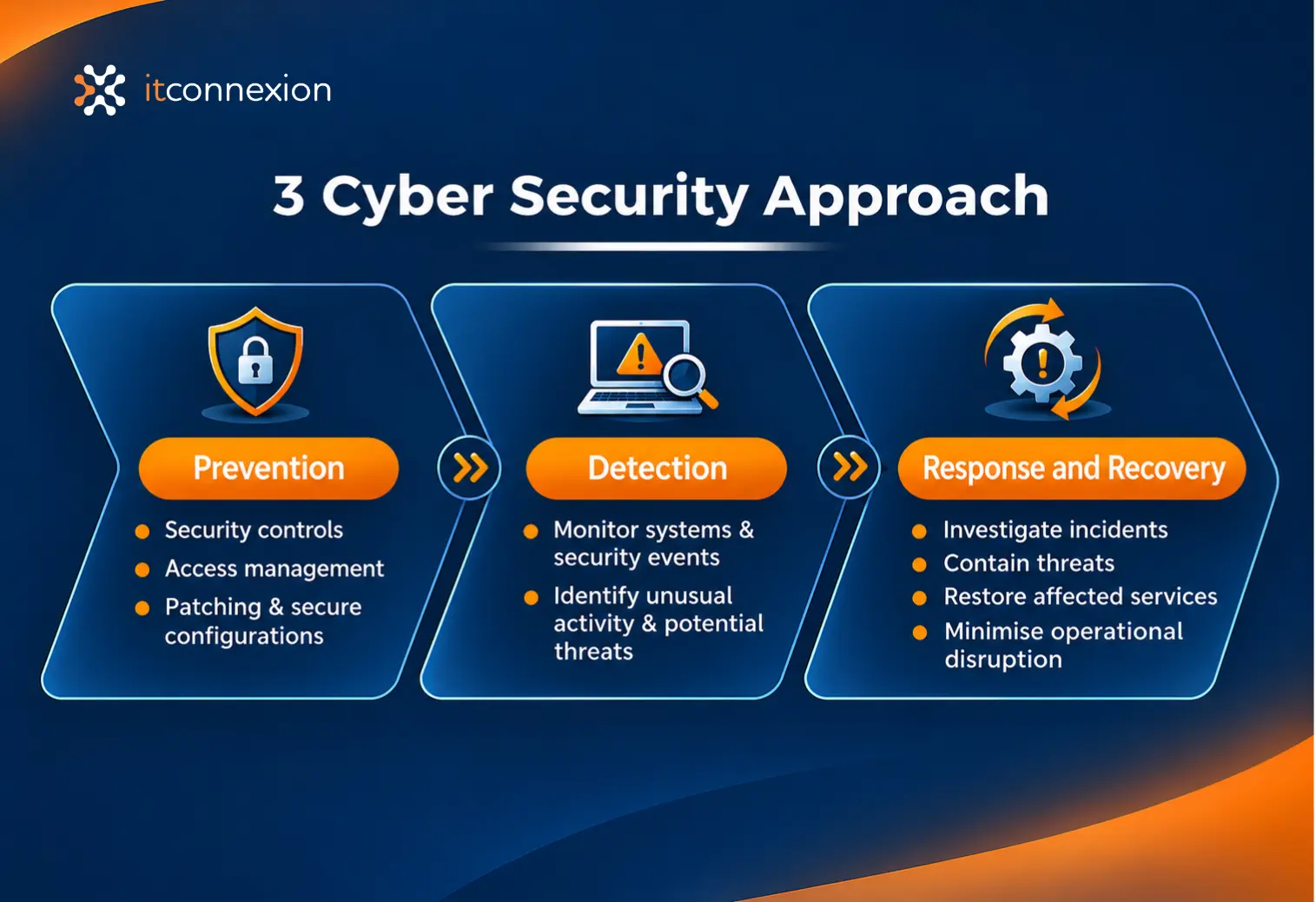
A resilient cyber security approach should include three important capabilities.
Reduce the likelihood of attacks through appropriate security controls, access management, patching and secure configurations.
Monitor systems and security events to identify unusual activity and potential threats before they escalate.
Investigate incidents, contain threats, restore affected services and minimise operational disruption.
These capabilities are important throughout the year, but become particularly valuable when organisations are operating with reduced resources.
The Importance of Continuous Security Monitoring
Cyber security monitoring is not simply about receiving automated alerts.
Effective monitoring involves identifying meaningful security events, assessing their potential impact and determining whether further investigation or action is required.
For example, an employee account suddenly accessing business information from an unusual location may warrant investigation. So might unexpected administrative changes, suspicious application behaviour or repeated attempts to access protected systems.
Some events may be harmless. Others could indicate compromised credentials or malicious activity.
The ability to distinguish between them requires appropriate security tools, expertise and response procedures.
This is where a Security Operations Centre (SOC) plays an important role.
A SOC provides a structured approach to monitoring, analysing and responding to cyber security events. With 24/7 monitoring, organisations can maintain security visibility beyond standard business hours, including weekends, public holidays and extended shutdown periods.
However, continuous monitoring should be supported by clearly defined response arrangements. Businesses should understand what is monitored, how incidents are escalated and what actions can be taken when key personnel are unavailable.
Business Continuity Means More Than Keeping Systems Online
Cyber security and business continuity are closely connected.
A business may have reliable infrastructure, cloud services and data backups, but an unexpected security incident can still interrupt operations.
Consider an organisation returning from its holiday break to discover that a critical business account has been compromised or an essential application is unavailable.
The resulting disruption could affect customer service, financial transactions, employee productivity and the ability to resume normal operations.
Business continuity planning should therefore consider more than system availability.
It should address how the organisation will respond to unexpected events, communicate with relevant stakeholders and restore essential services.
For Australian businesses, this includes understanding the responsibilities of internal staff, external technology providers and other parties involved in supporting critical systems.
A well-prepared organisation should be able to respond to an incident even when its usual decision-makers are away.
How ITConnexion Supports Businesses Beyond Business Hours
At ITConnexion, we understand that businesses depend on reliable, secure technology regardless of the time of day or season.
Our approach combines Managed IT Services, Cyber Security and Infrastructure Management to help organisations maintain secure and resilient digital environments.
Through our 24/7 Security Operations Centre (SOC) Reliable 24/7 IT Support Services | ITConnexion Australia, we provide continuous security monitoring to help identify, investigate and respond to potential cyber threats, including outside normal business hours.
This complements our broader managed IT capabilities, supporting organisations with the technical expertise, ongoing management and security oversight needed to operate with confidence.
For existing ITConnexion clients, the holiday period is also an opportunity to review current arrangements and confirm that security monitoring, incident escalation and IT support requirements align with their operational needs.
Whether your organisation is taking a complete break, operating with a smaller team or continuing business as usual, the right support arrangements can help reduce uncertainty and strengthen operational resilience.
Before You Switch Off, Know Who Is Looking After Your Business
The holiday season should be an opportunity for your team to recharge, knowing that essential business technology remains appropriately protected.
While preventative security measures are important, organisations should also consider what happens after everyone leaves the office.
Who is monitoring your systems? Who will investigate suspicious activity? And who can respond if something goes wrong?
These are questions worth answering before the holiday period begins.
At ITConnexion, we help Australian businesses maintain secure, reliable and supported IT environments throughout the year.
If you would like to review your organisation’s holiday IT arrangements, cyber security monitoring or business continuity readiness, our team is here to help.
Contact ITConnexion to discuss your cyber security requirements