When organisations begin reviewing their technology costs, IT support is often one of the first areas examined.
At first glance, changing providers can seem like a straightforward way to reduce operational expenses. New providers may promise similar services, attractive pricing, and a smooth transition process.
However, comparing IT providers based solely on monthly fees can sometimes overlook factors that have a far greater impact on business performance.
The reality is that the value of an IT provider is not measured only by what appears on an invoice. It is also reflected in service quality, responsiveness, reliability, productivity, business continuity, and the ability to support an organisation’s long-term objectives.
For business leaders, the goal is not necessarily to find the cheapest provider. It is to find the provider that delivers the right value for their organisation.
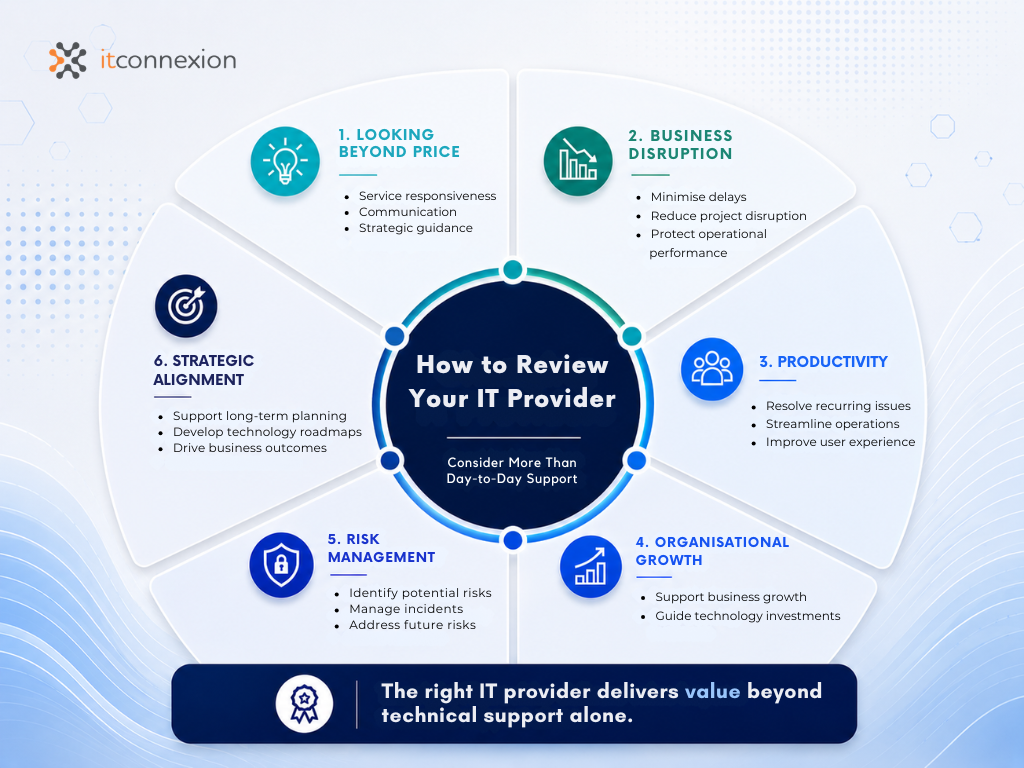
Looking Beyond Price
Price will always be an important factor when evaluating technology partners.
However, IT support agreements can vary significantly in scope, service delivery, communication, and strategic involvement.
Two providers may appear similar on paper while offering very different levels of support and expertise.
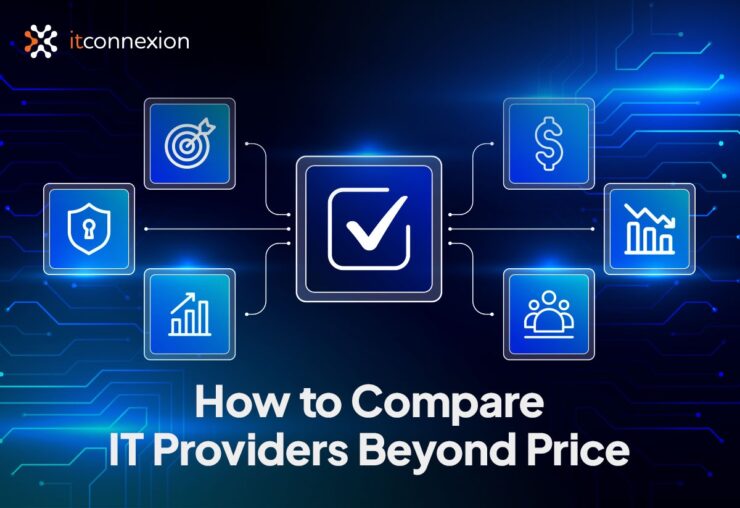
When reviewing potential providers, organisations should consider:
- Service responsiveness
- Communication and reporting
- Proactive management
- Business continuity planning
- Strategic technology guidance
- Security and risk management
- Scalability and future support
Looking beyond the monthly fee often provides a clearer picture of the overall value being delivered.
For organisations seeking to better understand their current environment before making a decision, an independent IT Health Check can provide valuable insight into existing strengths, risks and opportunities.
The Cost of Business Disruption
Technology plays a critical role in almost every modern organisation.
When systems are unavailable, performance slows, or issues remain unresolved, the impact often extends well beyond the IT department.
Employees may become less productive.
Customers may experience delays.
Projects can be disrupted.
Operational efficiency can decline.
While these impacts are not always immediately visible, they can accumulate over time and affect overall business performance.
This is why many organisations assess not only how providers respond to issues, but also how they help prevent them from occurring in the first place.
Reliable technology support contributes directly to business continuity, productivity and customer experience.
Productivity Matters
Not every technology issue results in a major outage.
In many cases, productivity is affected by smaller challenges that occur regularly across an organisation.
Examples may include:
- Slow devices
- Connectivity issues
- Application performance problems
- Collaboration challenges
- Repeated support requests
- Delayed issue resolution
Individually, these issues may appear minor.
Collectively, they can consume significant time and create unnecessary frustration for staff.
An effective technology partner should help organisations identify recurring issues, streamline operations and improve the overall user experience.
Technology should enable employees to focus on their work rather than the systems they depend on.
Supporting Organisational Growth
Technology requirements rarely remain static.
As organisations grow, evolve, or adapt to changing market conditions, their technology needs often become more complex.
This may include:
- Expanding locations
- Hybrid work environments
- Cloud adoption
- New business systems
- Compliance requirements
- Cyber security initiatives
- Digital transformation projects
When evaluating a provider, it is important to consider not only current requirements but also future business objectives.
The right technology partner should be capable of supporting organisational growth and helping leaders make informed decisions about future technology investments.
Organisations planning future technology initiatives may benefit from reviewing their broader Cloud Solutions and digital transformation strategies.
Risk Management Is Now a Business Priority
Technology decisions increasingly influence business risk.
Cyber security, operational resilience, data protection and business continuity have become important considerations for leadership teams across all sectors.
As a result, many organisations are placing greater emphasis on understanding how technology providers approach risk management.
Questions worth considering include:
- How are potential risks identified?
- How are incidents managed?
- How is business continuity supported?
- How are organisations kept informed?
- How are future risks addressed?
The answers can provide valuable insight into a provider’s approach and long-term suitability.
Organisations reviewing their resilience strategies may also wish to explore Business Continuity Planning as part of their broader risk management framework.
The Importance of Strategic Alignment
Technology should support business objectives.
The most effective provider relationships are built on a shared understanding of organisational goals, challenges and priorities.
Beyond day-to-day support, organisations should consider how providers contribute to:
- Long-term planning
- Technology roadmaps
- Operational efficiency
- Productivity improvements
- Risk reduction
- Business outcomes
A provider that understands your organisation can often deliver greater long-term value than one focused solely on technical support.
This is where comprehensive Managed IT Services can help organisations align technology investments with broader business priorities.
Questions to Ask Before Changing IT Providers
Before selecting a new provider, consider asking:
- How do you measure service performance?
- How do you communicate with clients?
- How do you proactively identify and resolve issues?
- How do you support business continuity?
- How do you help organisations plan for future technology needs?
- What reporting and review processes are provided?
- What industries and organisations do you typically support?
- How do you maintain service quality over time?
These discussions often provide a deeper understanding of how a provider operates than pricing comparisons alone.
Making an Informed Decision
Changing IT providers is an important business decision.
While cost should always be considered, it is only one part of the overall picture.
Service quality, responsiveness, business continuity, productivity, strategic alignment and long-term value all play a role in determining whether a provider is the right fit.
By taking a broader view of the evaluation process, organisations can make more informed decisions that support both immediate requirements and future goals.
Need an Independent Perspective?
Whether you’re reviewing your current IT arrangements or considering alternative providers, understanding your technology environment is an important first step.
ITConnexion works with organisations across Australia to help assess technology environments, identify opportunities for improvement, and support informed decision-making.
If you’d like an independent review of your current environment, consider starting with an IT Health Check to gain greater visibility into your technology, risks and opportunities.