Your organisation may already be using AI. But are you getting the most out of it?
Artificial intelligence is becoming part of everyday business operations. From drafting emails and summarising documents to researching information, many Australian organisations are already experiencing the convenience of AI.
But these everyday applications are only the beginning.
The real opportunity lies in using AI to reduce repetitive work, improve decision-making, streamline business processes and help employees focus on higher-value activities.
For many organisations, the challenge is no longer whether to adopt AI. It is understanding how to apply it more effectively across their operations.
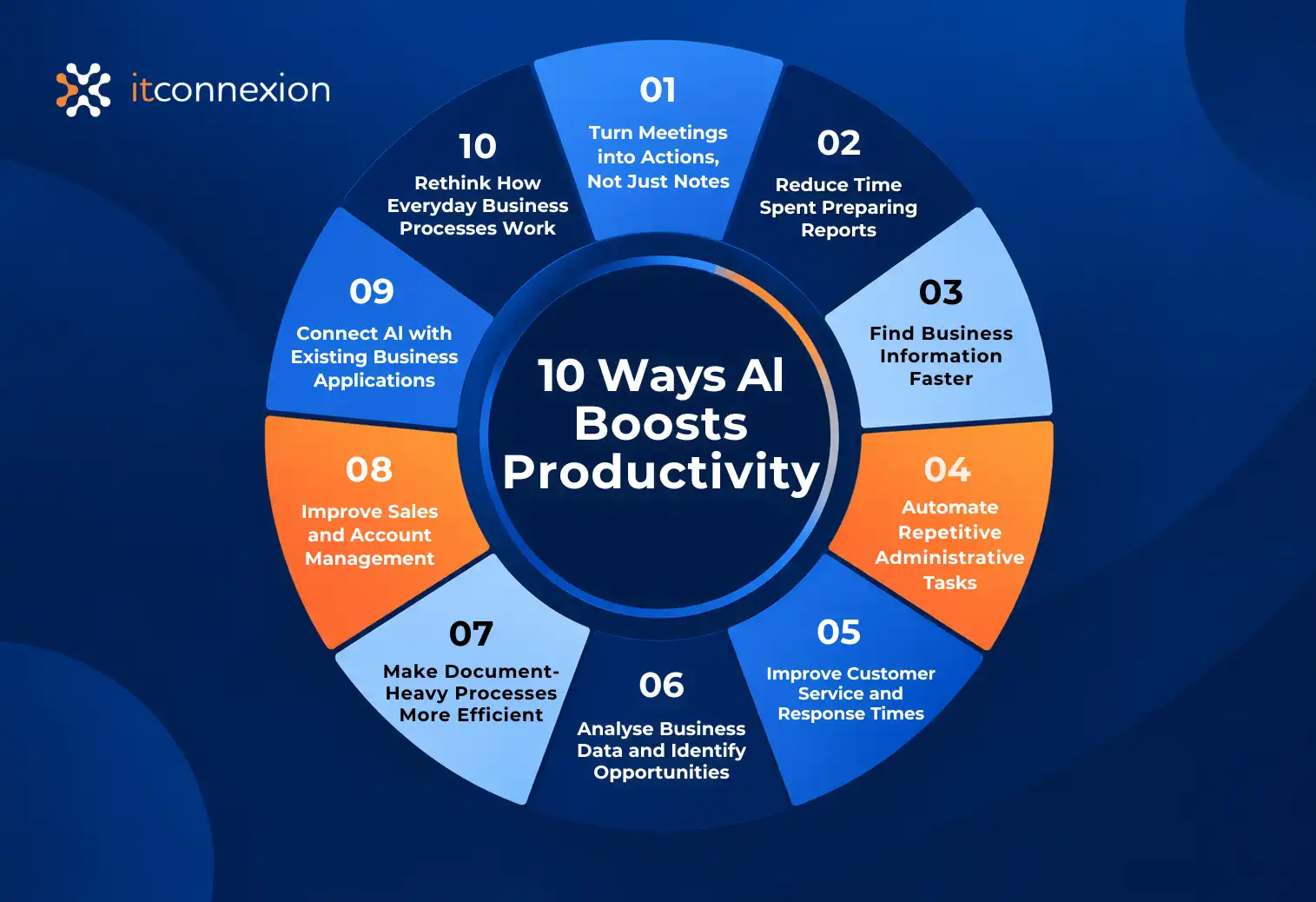
Here are 10 practical ways AI can improve business productivity, including opportunities your organisation may not have considered.
1. Turn Meetings into Actions, Not Just Notes
Meetings generate valuable information, but turning discussions into meaningful actions often requires additional administrative work.
AI can help by:
- Summarising meeting discussions and key decisions.
- Identifying action items and responsible team members.
- Preparing follow-up emails and meeting summaries.
- Helping track outstanding actions and commitments.
- Organising meeting information for future reference.
Practical example: Instead of spending 30 minutes preparing meeting notes and follow-up emails, a project manager could use AI to generate a structured summary and action list for review within minutes.
The business benefit: Less administration, clearer accountability and more time to focus on delivering outcomes.
2. Reduce Time Spent Preparing Reports
Many businesses spend considerable time compiling weekly, monthly or quarterly reports.
Information may need to be gathered from spreadsheets, business applications, emails and multiple departments before it can be presented to management.
AI can assist with:
- Summarising operational and financial information.
- Identifying patterns and unusual changes in data.
- Preparing first drafts of management reports.
- Highlighting key performance indicators.
- Turning complex information into easier-to-understand summaries.
Practical example: A department manager who spends several hours preparing a monthly performance report could use AI to help analyse approved business data, highlight important changes and draft an executive summary.
The business benefit: Faster reporting, more consistent information and more time for analysis and decision-making.
3. Find Business Information Faster
How much time do your employees spend searching for information?
Documents, policies, procedures, project records and historical correspondence are often scattered across multiple systems.
AI-powered knowledge retrieval can help employees find relevant information without manually searching through countless folders and files.
Potential applications include:
- Finding internal policies and procedures.
- Retrieving relevant project documentation.
- Locating product or service information.
- Answering common internal questions.
- Summarising information from multiple approved sources.
Practical example: Instead of searching through several folders to find a company procedure, an employee could ask an approved AI system a question and receive an answer with references to the relevant documents.
The business benefit: Faster access to organisational knowledge, reduced interruptions and improved employee productivity.
This is particularly valuable for organisations with large document libraries or teams working across multiple locations.
4. Automate Repetitive Administrative Tasks
Almost every organisation has routine administrative processes that consume valuable employee time.
These tasks may be necessary, but they do not always require significant human involvement.
AI, often combined with traditional workflow automation, can help with:
- Extracting information from forms and documents.
- Categorising incoming requests.
- Preparing routine correspondence.
- Updating records in approved business systems.
- Routing tasks to appropriate departments.
- Identifying incomplete or inconsistent information.
Practical example: An organisation receiving hundreds of forms each month could use AI to extract relevant details, identify missing information and prepare the records for staff verification.
The business benefit: Reduced manual handling, faster processing and fewer repetitive administrative steps.
The important distinction is that AI does not necessarily replace the entire process. It can improve individual steps while allowing employees to retain appropriate oversight.
5. Improve Customer Service and Response Times
Customers increasingly expect timely, accurate and consistent service.
AI can help customer-facing teams respond more efficiently by making information easier to access and reducing repetitive work.
Potential applications include:
- Summarising customer enquiries.
- Suggesting responses to frequently asked questions.
- Retrieving relevant product or service information.
- Categorising and prioritising incoming requests.
- Preparing customer interaction summaries.
- Assisting with routine service requests.
Practical example: A customer service employee receives a detailed enquiry requiring information from several internal documents.
Instead of searching through each document manually, an AI assistant could retrieve relevant information and prepare a suggested response for the employee to verify.
The business benefit: Faster responses, improved consistency and more time for employees to handle complex customer needs.
AI works best when it supports good customer service rather than removing the human judgement and relationships that customers value.
6. Analyse Business Data and Identify Opportunities
Many organisations collect large amounts of data but struggle to turn it into useful insights.
AI can help employees explore information and identify trends without requiring every user to have advanced data analysis skills.
For example, AI can assist with:
- Analysing sales performance.
- Identifying changes in customer demand.
- Reviewing operational trends.
- Comparing performance across departments.
- Highlighting potential inefficiencies.
- Explaining patterns within business data.
Practical example: A business manager could use AI to analyse historical sales information and identify which products, services or customer segments have experienced significant changes.
The results can then be reviewed alongside other business factors to support better decisions.
The business benefit: Faster analysis, improved visibility and more informed business decisions.
Of course, the quality of AI-generated insights still depends on the accuracy and completeness of the underlying data.
7. Make Document-Heavy Processes More Efficient
Many industries depend heavily on documents.
Professional services firms, healthcare providers, educational institutions, not-for-profit organisations and financial services businesses often manage large volumes of forms, reports, policies, agreements and other records.
AI can help employees:
- Summarise lengthy documents.
- Extract important information.
- Compare document versions.
- Identify missing sections.
- Categorise documents.
- Prepare summaries for review.
Practical example: A professional services team reviewing a collection of lengthy documents could use AI to identify relevant sections, extract key information and prepare a consolidated summary.
Employees would still review the findings, particularly where legal, financial, regulatory or other important decisions are involved.
The business benefit: Less time spent on repetitive document handling and more time for professional analysis and judgement.
8. Improve Sales and Account Management
Sales and account management teams often spend significant time preparing for meetings, reviewing customer information and managing follow-up activities.
AI can assist with:
- Preparing customer meeting briefs.
- Summarising previous interactions.
- Drafting proposals and follow-up communications.
- Identifying outstanding customer actions.
- Organising account information.
- Preparing sales performance summaries.
Practical example: Before a customer meeting, an account manager could use AI to prepare a briefing based on authorised account records, previous meeting notes and outstanding actions.
After the meeting, AI could assist with preparing a summary and follow-up tasks.
The business benefit: Less administrative work, better preparation and more time building customer relationships.
9. Connect AI with Existing Business Applications
This is where AI can move beyond being a standalone productivity tool.
Many organisations already rely on multiple applications to manage finance, operations, customer relationships, projects and internal communications.
When appropriately integrated with these systems, AI can help streamline processes that currently require employees to move information manually between applications.
For example, an AI-assisted workflow might:
- Receive and categorise an incoming business request.
- Extract relevant information.
- Retrieve supporting information from an approved system.
- Prepare a recommended response or next action.
- Route the request to the appropriate employee for review.
- Update the relevant business record after approval.
Not every step requires AI. In many cases, the most effective solution combines AI, conventional automation and existing business applications.
The business benefit: Fewer manual handovers, more consistent processes and better use of existing technology investments.
This is also where organisations may begin to discover productivity opportunities that are not immediately obvious from using an AI chatbot alone.
10. Rethink How Everyday Business Processes Work
Perhaps the greatest long-term opportunity is not simply using AI to complete existing tasks faster.
It is reconsidering whether those tasks need to be performed in the same way at all.
Consider a process that involves multiple employees collecting information, reviewing documents, preparing summaries, seeking approvals and updating different systems.
Instead of applying AI to just one part of that process, organisations can examine the entire workflow.
Could some information be collected automatically?
Could AI help prepare the initial analysis?
Could routine steps be automated?
Could employees focus primarily on exceptions, approvals and decisions?
Practical example: An operations team might redesign a recurring reporting process so information is collected automatically, AI assists with analysis and employees concentrate on validating findings and deciding what action to take.
The business benefit: More efficient workflows, improved operational capacity and opportunities to scale without simply increasing administrative workload.
This is the difference between using AI as a tool and using AI to improve how your organisation operates.
Getting More Value from AI Starts with the Right Questions
The opportunities above demonstrate that AI can contribute to business productivity in many different ways.
But not every process needs AI, and not every AI application will deliver a worthwhile return.
The best starting point is to understand your organisation’s existing workflows and identify where time, resources or effort are being unnecessarily consumed.
Ask your team:
- Which tasks are repeated most frequently?
- Where do employees spend too much time searching for information?
- Which processes involve unnecessary manual steps?
- What information could help us make better decisions?
- Which activities would benefit from faster turnaround times?
- Where could employees deliver greater value if administrative work were reduced?
These questions can reveal opportunities for AI, automation or improvements to your existing systems.
It is also important to consider security, privacy, data quality and human oversight when evaluating new AI applications.
For organisations reviewing those foundations, our earlier article, Is Your Business IT Ready for AI?, explains the important technology and security considerations.
From AI Experimentation to Measurable Business Value
Using AI occasionally to write an email or summarise a document can save time.
But the greater opportunity comes when organisations identify repeatable applications that deliver measurable improvements across their operations.
That means looking beyond the number of AI tools or licences your organisation has.
Instead, consider:
- Time saved: Are employees completing tasks faster?
- Process efficiency: Have unnecessary manual steps been reduced?
- Information accessibility: Can employees find what they need more easily?
- Service quality: Are customers receiving faster, more consistent responses?
- Operational capacity: Can teams handle more work without a proportional increase in administrative effort?
- Business value: Are improvements meaningful enough to justify the investment?
Start with a manageable use case, establish a baseline, measure the results and expand when the value is demonstrated.
The goal is not to use more AI. It is to get better business outcomes from the technology you use.
What Could AI Do for Your Organisation?
Your business may already be using AI every day.
But are you making the most of it?
There could be opportunities within your existing operations to reduce repetitive work, streamline processes, improve productivity and make better use of the technology you already have.
At ITConnexion, we believe technology should help organisations work smarter, operate more efficiently and adapt to changing business needs.
With more than two decades of experience supporting Australian organisations, ITConnexion continues to evolve alongside emerging technologies, helping businesses understand how innovations such as AI can deliver practical value.
Discover Where AI Could Make a Real Difference
Not sure where to start, or what else AI could do for your organisation?
Talk to an ITConnexion AI Specialist about your existing workflows, productivity challenges and potential opportunities for AI and automation.
Whether you’re looking to reduce manual work, improve business processes or explore new ways to make your operations more efficient, we’re here to help you identify practical next steps.